

Table of Contents
- Understanding SASE
- Key Components of SASE
- Benefits of Adopting SASE
- Implementing SASE in Your Organization
- Challenges and Considerations
- Future Trends in SASE
- Conclusion
As digital transformation accelerates across industries, secure, high-performing cloud connectivity has become essential for business growth and operational resilience. Enterprises increasingly turn to Secure Access Service Edge (SASE) solutions to optimize network security and streamline access. The evolution of SASE cloud architectures ensures that users and devices enjoy seamless, secure connectivity, no matter where they are. For organizations new to the concept, understanding modern SASE cloud models can be the key to unlocking scalable, agile, and future-proof cloud connectivity. To learn more about integrated solutions that deliver secure, unified access, visit SASE Cloud.
Modern SASE approaches represent a convergence of proven security frameworks with advanced WAN capabilities. As businesses embrace hybrid work environments and expand their use of SaaS, public clouds, and private clouds, they face new challenges in managing threats and ensuring performance for every connection. SASE provides the foundation to blend cloud-native security with agile networking, meeting the unique demands of digital transformation.
Central to SASE’s value is its delivery of security-as-a-service, combined with intelligent networking. By shifting traditional security perimeters to the cloud and orchestrating everything on a single platform, organizations benefit from simplified operations, more vigorous policy enforcement, and better user experiences. This makes SASE a strategic investment for companies aiming to stay ahead in today’s threat landscape.
Another notable aspect of modern SASE solutions is their adaptability. SASE architectures are designed to fit varied scaling requirements, making them suitable for both growing enterprises and global organizations with complex networks. The future of secure connectivity lies in flexible, policy-driven frameworks like SASE, which empower businesses to evolve without sacrificing protection.
Understanding SASE
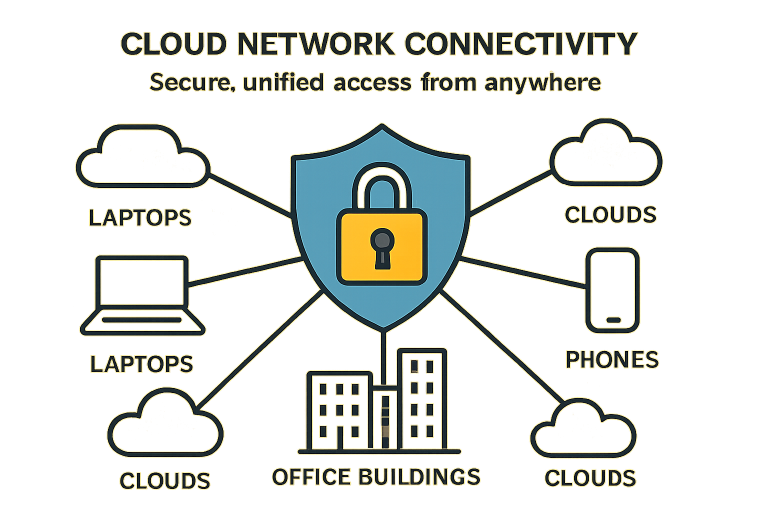
Secure Access Service Edge (SASE) is a cloud-native technology framework that unifies networking and multiple security services into a global, distributed platform. The traditional security perimeter, once confined to a corporate office, has dissolved as organizations move resources to the cloud and enable distributed workforces. SASE responds to these new realities by enabling centralized policy enforcement while providing consistent, secure access from any location or device.
Gartner first introduced SASE as an architecture that combines wide area networking with robust security services, delivered as a cloud service. This model supports modern IT strategies by prioritizing secure, direct-to-cloud connections that are scalable and easier to manage than legacy hardware-based systems. The flexibility of SASE makes it particularly valuable for businesses navigating multi-cloud environments, remote work, and expanding digital services.
For an in-depth explanation of the SASE approach and its business value, see this CSO Online resource.
Key Components of SASE
- Software-Defined Wide Area Network (SD-WAN): SD-WAN serves as the transport layer of SASE, enabling organizations to optimize application performance by dynamically routing traffic over the most efficient network paths, often combining internet, MPLS, and LTE connections for maximum resilience and speed.
- Firewall-as-a-Service (FWaaS): Providing firewall capabilities from the cloud, FWaaS eliminates the need for dedicated security appliances in each office, ensuring that all traffic, regardless of origin, passes through unified inspection and threat-prevention controls.
- Secure Web Gateway (SWG): SWG solutions block access to malicious websites and enforce compliance with corporate policies by filtering web traffic, which helps prevent data breaches and infections from web-based attacks.
- Cloud Access Security Broker (CASB): A CASB provides visibility and control over user activity in cloud applications, allowing organizations to enforce approved usage, prevent data leakage, and manage shadow IT risks.
- Zero Trust Network Access (ZTNA): Unlike traditional VPNs, ZTNA provides application-specific access based on user verification and context, upholding a zero-trust principle that minimizes exposure and limits lateral movement by attackers.
Benefits of Adopting SASE
- Enhanced Security: SASE leverages automated threat intelligence, user behavior analytics, and continuous policy enforcement to provide robust protection across networks and endpoints.
- Improved Performance: SD-WAN routes critical traffic through optimal channels, reducing latency for cloud applications and remote work solutions.
- Scalability: Cloud-native SASE platforms allow organizations to scale bandwidth, security coverage, and policy enforcement up or down instantly, with minimal operational overhead.
- Cost Efficiency: Consolidating security and network management into a unified platform reduces hardware investments, streamlines operations, and lowers maintenance costs.
Implementing SASE in Your Organization
- Assess Current Infrastructure: Begin by mapping existing networks, users, and applications to identify security gaps and infrastructure limitations.
- Define Security Policies: Develop policies that reflect your company’s security requirements, regulatory obligations, and strategic goals.
- Select a SASE Provider: Evaluate vendors based on the breadth of functionality, integration capabilities, and the maturity of their cloud platform. Proven experience and comprehensive coverage are essential for long-term success.
- Plan for Integration: Gradually roll out SASE services, prioritizing critical sites and users to minimize disruptions to business processes.
- Monitor and Optimize: Use SASE’s built-in analytics and monitoring tools to track performance, flag threats, and continuously optimize for both user experience and security outcomes.
Challenges and Considerations
- Complexity of Integration: Migrating to SASE means merging multiple security and networking functions, which may involve significant architectural changes and organizational alignment.
- Vendor Lock-in: Choosing a single SASE provider can limit flexibility and make future changes difficult, so it is essential to evaluate a provider’s adaptability and roadmap.
- Skill Gaps: SASE implementations require expertise across cloud, security, and networking domains. Investing in upskilling and training is essential to derive the full value of your solution.
For more on overcoming SASE challenges and scaling security for the cloud, see this guide from TechRepublic.
Future Trends in SASE
- AI and Machine Learning Integration: SASE vendors increasingly integrate AI-based analytics to detect sophisticated threats, automate response actions, and streamline operations.
- Clientless SASE: Advancements in browser isolation and zero trust architectures are enabling secure, agentless connections to sensitive resources. This reduces friction for end users and simplifies management.
- 5G and Edge Computing: The expansion of 5G networks and edge computing capabilities allows SASE solutions to deliver faster, geographically distributed processing and security for IoT and mobile-first workforces.
Conclusion
As demand for secure, scalable cloud access grows, modern SASE approaches provide organizations with an agile, integrated framework for networking and security. By adopting SASE, businesses can ensure consistent protection for every user, device, and cloud workload while supporting innovation and digital agility. Keeping pace with trends in AI and edge computing will be vital to fully leveraging the power of SASE in the coming years.
