

Table of Contents
- Evolution of In-Car Voice Assistants
- Enhancing Driver Safety
- Personalization and User Experience
- Integration with Smart Home Devices
- Monetization and Voice Commerce
- Challenges and Future Prospects
Voice assistants have fundamentally changed how drivers and passengers interact with their vehicles. The introduction of highly capable voice AI systems is not only raising the bar for convenience but is also fostering a safer, more connected, and personalized journey for everyone in the car. Platforms like the SoundHound voice AI platform for the automotive industry are exemplifying these advances, redefining how carmakers and tech developers approach in-car experiences.
Whether it is hands-free navigation, controlling car functions, or connecting to other smart devices, today’s voice assistants are no longer a luxury. They have become central to the next generation of automotive technology, providing drivers with an intuitive and distraction-free interface. As cars become more intelligent, the in-car voice assistant is rapidly emerging as the user’s primary point of interaction. With this, a new era of mobility and convenience unfolds on the road.
This transformation is supported by breakthroughs in artificial intelligence and machine learning. These technologies enable vehicles to understand conversational language, anticipate needs, and adapt to the unique preferences of each driver and passenger. The combination of convenience, connectivity, and predictive intelligence is making the driving experience not just more enjoyable but fundamentally safer and smarter.
The evolution of in-car voice assistants is also changing how automakers and technology companies think about product integration and user experience. The impact extends beyond the confines of the vehicle, reaching into connected homes and digital ecosystems.
Evolution of In-Car Voice Assistants
The first voice-controlled features in vehicles were limited to simple command-and-control tasks, such as dialing a contact or adjusting the volume. As natural language processing technology matured, voice assistants became far more helpful and engaging. Modern systems, powered by advanced AI, can interpret complex, conversational requests, understand context, and deliver information or perform tasks with near-human-like responsiveness. Recent innovations have enabled a more accurate understanding regardless of background noise, regional accents, or multiple users, marking a significant leap from their modest beginnings.
This ongoing innovation is driven by consumer expectations for seamless experiences that integrate naturally into their daily routines. As these systems continue to improve, automakers are seeking to provide voice assistants that feel less like tools and more like digital co-pilots, delivering a sense of companionship and support. Driven by a desire for greater comfort and ease-of-use, the automotive industry is embracing rapid advancements in AI, cloud computing, and over-the-air updates, ensuring that their voice assistants will only become more advanced and integrated into the overall driving experience in the coming years.
Enhancing Driver Safety
Safety remains a top priority for automakers and drivers alike. Voice assistants play an essential role in reducing on-road distractions by eliminating the need to interact with screens or controls. Drivers can set navigation routes, answer messages, or change music through voice commands, all while keeping their hands on the wheel and eyes on the road. The National Highway Traffic Safety Administration (NHTSA) emphasizes the importance of minimizing distractions to decrease accident risk. As a result, voice AI is rapidly becoming a standard feature in new models, helping to uphold higher safety standards across the industry.
Furthermore, the inclusion of advanced voice assistants in new vehicles is spurring innovation in real-time safety notifications and alerts. Modern systems can now provide proactive warnings related to road conditions and vehicle status through natural language, alerting drivers to potential hazards before they become critical. This layer of smart communication not only supports a safer driving environment but also enables faster response to emergencies, underscoring how integral voice interfaces have become in advancing road safety.
Personalization and User Experience
One of the standout benefits of voice assistants in vehicles is their capacity for personalization. These systems learn from user interactions to adapt everything from preferred routes and climate settings to multimedia choices. Drivers can enjoy seamless transitions from one trip to the next, with voice AI remembering customization preferences for different scenarios. Over time, this intelligence creates a more harmonious and user-friendly environment, transforming the in-car experience into a truly personalized journey for every occupant.
Integration with Smart Home Devices
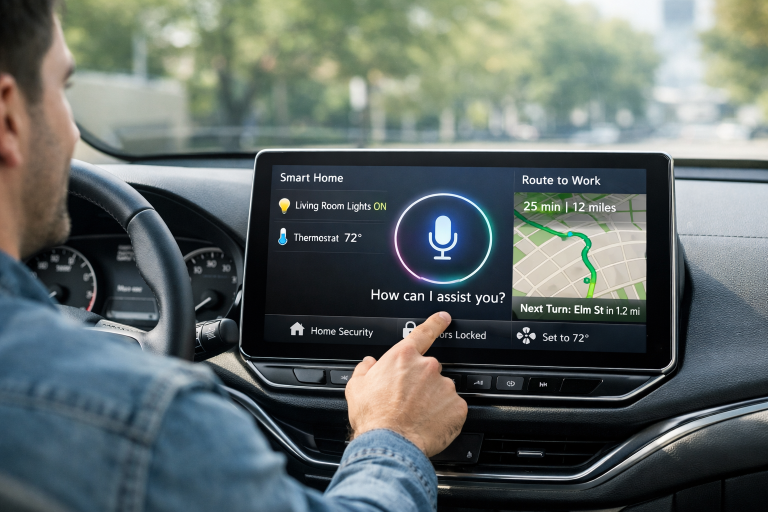
In today’s interconnected world, a car is rarely just a means of transport. Voice assistants bridge the gap between the vehicle and the home, enabling users to manage smart thermostats, lights, and even security systems while traveling. This functionality offers an unprecedented level of convenience and control. For example, drivers can ensure their house is comfortable and secure before even arriving home. This integration is a significant step toward the future of connected living, where every aspect of daily life can be managed fluidly from any location.
As technology progresses, these integrations are expected to broaden, with voice assistants facilitating more sophisticated cross-platform interactions. The expansion of such features will usher in new routines for users, as the boundaries between home, work, and travel continue to blur. This seamless connectivity will be essential as smart cities and enhanced vehicle-to-everything (V2X) communication networks become more widespread.
Monetization and Voice Commerce
Voice commerce represents the leading edge of monetization possibilities for carmakers. With in-car voice AI, drivers now order food, reserve parking, and pay for services without ever needing to leave the vehicle. Automakers are collaborating with brands and service providers to shape a new ecosystem where commerce can be conducted securely, efficiently, and seamlessly from the driver’s seat. According to MOTOR, these evolving partnerships are not only providing unparalleled value to users but are also unlocking new revenue streams for the automotive industry.
This monetization extends beyond classic transactions; subscription services, exclusive audio content, and even digital goods can be purchased with just a few spoken words. The efficiencies introduced by this hands-free commerce have the potential to redefine user expectations for services on the go. As trust in voice transactions strengthens, we will likely see a dramatic expansion in offerings and in the frequency of in-car commercial activities, reshaping how both consumers and companies think about convenience and marketplace engagement.
Challenges and Future Prospects
Even as voice assistants gain sophistication, several challenges persist. Ensuring consistent recognition of global accents, processing commands accurately in noisy environments, and protecting user data privacy remain top concerns. Technology companies and automakers are investing heavily in AI model advancements and security protocols to address these issues. Looking ahead, the continued evolution of AI and deep learning techniques is expected to resolve many of these hurdles, paving the way for even more reliable and intuitive voice-enabled vehicles. As innovation accelerates, drivers can expect voice assistants to become essential, trusted copilots that continually adapt to the future of mobility.
Beyond technical improvements, manufacturers must address regulatory, ethical, and societal implications as AI systems collect and process ever-greater volumes of personal data. Transparent policies, strict adherence to privacy regulations, and ongoing user education will become critical elements for widespread adoption. Ultimately, industry leaders who prioritize these challenges and communicate openly with users will have a distinct advantage in building lasting trust and loyalty amid the shift to intelligent, voice-first vehicles.
Ultimately, as technology evolves and digital ecosystems expand, in-car voice assistants are shaping the way we travel. They bring together safety, convenience, personalization, and connectivity in a way that was unimaginable only a few years ago. The result is a transformation in how people experience, interact with, and enjoy their vehicles.

